
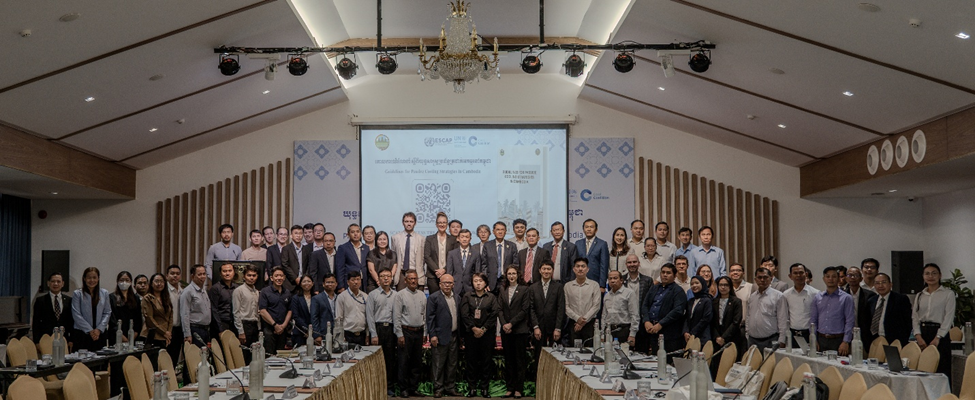

Phnom Penh, 21 January 2026 – The Ministry of Environment, with support from the United Nations Economic and Social Commission for Asia and the Pacific (UN ESCAP) and the United Nations Environment Programme (UNEP) within the framework of the Cool Coalition, convened the South-East Asia Regional Workshop on Passive Cooling Strategies for Sustainable Development in Cambodia.The workshop underscored passive cooling as a high-impact, low-cost solution capable of significantly reducing building energy demand, lowering peak electricity loads, improving thermal comfort, and strengthening climate resilience — making it a major contributor to Cambodia’s international commitments under its NDC 3.0 and national energy demand reduction targets under the National Energy Efficiency Policy (NEEP).
The workshop brought together around 98 participants, including 22 women, from government institutions, development partners, academia, and the private sector across the Asia-Pacific region. The workshop provided an opportunity to share Cambodia’s experience in promoting passive cooling strategies in policy and practice, and to discuss ways to scale up sustainable cooling practices in the building sector as a pathway to reduce long-term energy demand growth, avoid costly power system expansion, and support affordable cooling access for households and businesses..The opening session included high-level remarks from regional and national leaders of ministries, highlighting the importance of passive cooling in responding to rising temperatures, increasing energy demand, and climate change impacts. Ms. Armida Salsiah Alisjahbana, Executive Secretary of UN ESCAP, emphasized the role of passive cooling in supporting climate-resilient urban development across Asia and the Pacific. Ms. Dechen Tsering, Asia-Pacific Regional Director of UNEP, highlighted passive cooling as a key solution to reduce energy demand and greenhouse gas emission in the building sector. H.E. Dr. Chuop Paris, Secretary of State, Ministry of Environment, reaffirmed Cambodia’s leadership in sustainable cooling, officially launched the Guidelines for Passive Cooling Strategies in Cambodia, and noted that passive cooling supports national priorities under the Pentagonal Strategy and contributes to the implementation of the Circular Strategy on Environment 2023–2028.

In his keynote presentation, Mr. Ouk Navann, Deputy General Director of the General Directorate of Policy and Strategy at the Ministry of Environment, presented Cambodia’s progress on sustainable cooling under the National Cooling Action Plan (NCAP) and its contribution to national climate and development goals. He noted that “if we think carefully about passive cooling design today, we will enjoy improved wellbeing in the future.”
Ms. Kimberly Roseberry, Economic Affairs Officer, UN ESCAP, highlighted the project outcomes and key findings, adding that “the results from Cambodia’s passive cooling demonstration show that good building design can reduce cooling energy demand and improve thermal comfort, while providing strong evidence for policy and practice,” with implications for scaling up across the building stock to help meet national efficiency and climate targets.

Under the theme “From Evidence to Practice,” a technical insights and policy dialogue session allowed participants to learn about key findings from Cambodia’s passive cooling demonstration project, including building performance, thermal comfort improvements, and energy-saving potential — demonstrating how passive measures can substantially reduce reliance on mechanical air conditioning and associated electricity consumption.
Mr. Andéol Cadin, Architect and Sustainable Urban Development Expert, presented the main technical results from the demonstration project. This was followed by a high-level panel discussion on how to apply these technical findings into building design, regulations, and construction practices to mainstream passive cooling into future building codes and urban development plans. The panel included Ms. Kimberly Roseberry, Economic Affairs Officer, ESCAP; H.E. Pak Sokharavuth, Under-Secretary of State, Ministry of Environment; Dr. Kinnaleth Vongchanh of the Institute of Technology of Cambodia, Mr. Mark Low of Urbanland, and Mr. Cadin.
The workshop also invited other countries in the Asia-Pacific region to share their experience in a panel moderated by Mr. Gennai Kamata, Associate Programme Officer on Buildings and Energy at UNEP. Speakers highlighted good practices and lessons learned in integrating passive cooling into urban planning, buildings and policy with case studies from Hong Kong, Indonesia, India, Singapore and also a regional perspective from the ASEAN Centre for Energy. An open discussion moderated by H.E. Pak Sokharavuth allowed national stakeholders to contribute and share their thoughts on scaling passive cooling strategies in Cambodia, including identifying policy, financing, and capacity-building actions needed to accelerate implementation at scale.
A key highlight of the workshop was the introduction of the upcoming ASEAN Passive Cooling Roadmap, presented by Mr. Rio Jon Piter Silitonga from the ASEAN Centre for Energy (ACE), which will outline a regional approach to scale up passive cooling strategies.
The workshop concluded with reflections from development partners and stakeholders on next steps for cooperation, financing, and implementation. Closing remarks were delivered by H.E. Pak Sokharavuth, Under-Secretary of State, Ministry of Environment, emphasized Cambodia’s continued commitment to advancing passive cooling as part of climate-resilient and energy-efficient development and encouraged stakeholders to translate discussions into concrete actions that will deliver measurable energy savings, emissions reductions, and improved living conditions for communities across the country.

